


CoolRead- Enchanting Reads
Apps and Live Wallpapers by Juu
I spent time with CoolRead- Enchanting Reads as a reading-focused personalization app, and my first impression was that its appeal depends less on flashy extras and more on whether it makes opening a story feel comfortable. Its store message points toward discovering a favorite story and reading wherever you are, but the useful question is how well that idea works for different people, places, and reading habits. In my experience, the app is most interesting for readers who want a simple way to settle into fiction on a phone rather than manage a large collection of unrelated tools.
That focus also makes the app easier to judge honestly. It is not something I would recommend automatically to every reader. People who need advanced reading controls, a highly customizable interface, or a mature accessibility toolkit may find the experience limited. On the other hand, someone who wants a lightweight reading companion and prefers a less complicated starting point may appreciate its direct approach. I looked at it through that practical lens: how easy it is to read, how it behaves for different abilities, and what happens when the surrounding situation is less than ideal.
How comfortably can you read and move around?
A calm starting point for casual reading
The strongest part of CoolRead is its clear purpose. Instead of presenting itself as a general entertainment hub, it is built around stories and the habit of returning to them. That matters for readers who lose interest when an app makes them pass through too many unrelated screens before reaching the content. I found the concept approachable for short reading sessions, such as a few pages during a break or a longer session at home.
The app belongs to the personalization category, which is a useful clue about its role. I would treat it as something that shapes a personal reading experience rather than as a replacement for every dedicated ebook platform. That distinction is important: if you already rely on a full library manager, annotation system, or specialized reader, CoolRead may work better as a discovery-oriented companion than as your only reading environment.
Navigation is especially important for people with attention, memory, or processing difficulties. A reading app can become tiring when the reader must repeatedly remember where a story was found, which control changes the page, or how to return to the previous view. CoolRead’s straightforward identity helps reduce that mental load, but I would still advise new users to spend a few minutes learning the basic movement between discovery and reading before settling into a long session.
Related News

Why WhatsApp Messenger Still Makes Everyday Communication Feel Easy

Jurassic World: The Game Is the Better Dino Tycoon for Strategic Players

Threads in Real Life: Who Should Join, Lurk, or Leave

How SHEIN Turned Shopping Into an Endless Content Feed

How to Make Fortnite Feel Smarter on Mobile

Should You Switch to Microsoft Outlook on Mobile?
Readability is more than font size
When I assess a reading app, I do not look only for large text. I also pay attention to spacing, visual density, contrast, the amount of information competing for attention, and whether controls feel separated from the words. These details affect readers with low vision, dyslexia, migraines, concentration difficulties, or simply tired eyes. CoolRead is appealing when the screen feels uncluttered, but its value will depend on how comfortable the individual presentation is for you.
I would test it with a short passage before committing to a long reading routine. Try the app in your usual lighting, hold the phone at the distance you normally use, and check whether your eyes remain relaxed after several minutes. A layout that looks attractive in a quick glance may still feel cramped during sustained reading. This is one of the most useful practical checks because personal comfort varies more than a general store description can show.
Another helpful habit is to choose a consistent reading position. If you move between portrait and landscape viewing, or frequently switch between a phone and another device, notice whether that change makes the text harder to follow. Readers with visual tracking difficulties may benefit from keeping one orientation and one comfortable distance rather than adjusting the screen repeatedly. I would not assume that a single default presentation suits everyone.
Gallery
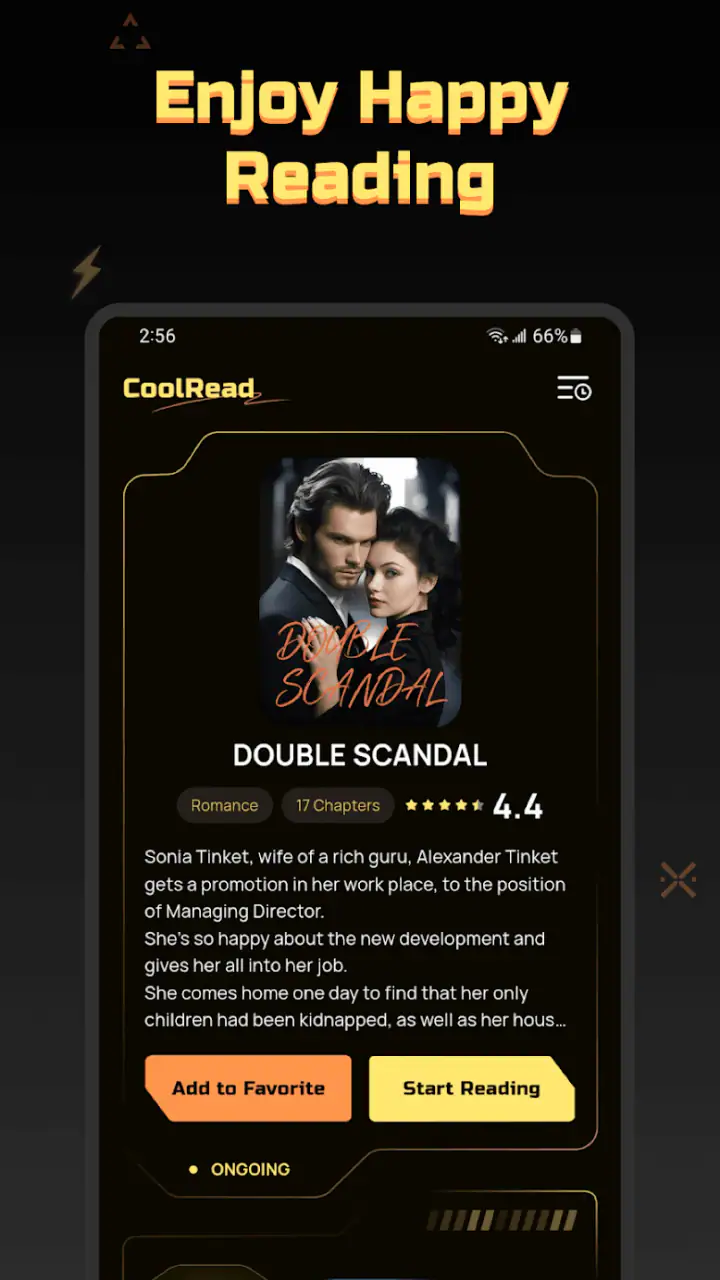
Discovery can help, but it can also distract
The promise of finding a next favorite story is useful for readers who do not arrive with a specific title in mind. Discovery can remove the pressure of deciding what to read next, especially after finishing a book and feeling unsure where to go. I enjoyed that kind of open-ended browsing more than I expected because it turns the app into a small reading ritual rather than a purely functional library.
Still, discovery is not automatically accessible. Someone with attention regulation challenges may find an endless choice of stories tiring instead of helpful. If browsing starts to feel like work, I recommend deciding on a simple rule before opening the app: choose the first appealing option after a brief scan, or use it only when you genuinely want suggestions. That keeps the discovery side from replacing the reading itself.
Who benefits from this reading style?
CoolRead makes the most sense for casual readers, people building a regular reading habit, and anyone who enjoys choosing a story based on mood. It can also suit a user who wants a focused app rather than a large ecosystem filled with shopping, social functions, or technical settings. The experience feels more approachable when the goal is “help me find something enjoyable to read” rather than “give me complete control over every part of a digital library.”
I would be more cautious if you need professional-level organization. Students who rely on detailed notes, researchers who need precise references, and readers who frequently move files between services may prefer a dedicated ebook or document reader. CoolRead’s charm is its simplicity, and simplicity becomes a weakness when your reading workflow depends on extensive management.
Motor and sensory considerations in daily use
Touch interaction can be difficult for people with tremors, limited dexterity, joint pain, or reduced precision. Reading apps often place important actions near the edges of the screen, where accidental taps and awkward hand positions are more likely. With CoolRead, I would use the app in a way that minimizes repeated gestures: support the phone, avoid holding it one-handed for an extended session, and pause rather than trying to correct a mistaken tap quickly.
A stand or a stable surface can make a larger difference than another app setting. It reduces the need to grip the device continuously and helps users who experience hand fatigue. For someone with motor limitations, that may be the most realistic improvement available because it changes the physical task without requiring a complicated setup inside the app.
Sensory comfort also includes motion, brightness, and interruption. Bright screens can become uncomfortable in dark rooms, while glare makes reading difficult outdoors. I would adjust the phone’s system brightness and avoid judging the app in only one environment. If you are sensitive to visual movement or sudden changes, use a quieter setting and disable unrelated phone interruptions during reading when possible. Those steps do not add a new CoolRead feature, but they can make the overall session easier to tolerate.
Readers who are sensitive to sound should also think about the surrounding phone environment. A quiet reading experience can be spoiled by notifications, media playback, or incoming calls. I recommend beginning a session with the device’s normal focus or silent controls, especially when reading in bed, in a waiting room, or during a commute. This is a small workflow change, but it protects concentration better than repeatedly recovering from interruptions.
Situational access: where the app fits best
CoolRead is naturally suited to flexible moments: a quiet afternoon at home, a short wait before an appointment, or a low-pressure evening routine. In those situations, I can imagine opening it without needing a long preparation process. The app’s value is less about replacing a physical book everywhere and more about keeping a story available when carrying a book is inconvenient.
Public transport is a more complicated example. A moving vehicle, changing light, and frequent interruptions can make screen reading tiring. If you experience motion sensitivity, reading on a bus or in a car may not be comfortable even when the app itself is easy to use. I would use CoolRead during stationary parts of a journey and switch to another activity when the environment starts causing eye strain or nausea.
Outdoor use brings its own trade-offs. Sunlight can reduce contrast, and glare may force you to hold the phone at an awkward angle. Readers with low vision may find that a familiar indoor setup works far better than a bright outdoor location. A shaded seat, a matte screen protector, or simply choosing a different time of day can help, but these are environmental solutions rather than proof that the app has specialized outdoor support.
Shared spaces also affect access. If you read in a library, office, or waiting area, privacy and noise may matter as much as text clarity. A short session with headphones is not necessarily appropriate if you need to remain aware of announcements, and a bright screen may disturb others. I like that a story app can fit into small pockets of time, but I would still choose the setting carefully instead of assuming every spare minute is a good reading opportunity.
A realistic everyday routine
Imagine finishing work with fifteen minutes before an appointment. You do not have enough time to start a complicated task, but you want something more engaging than scrolling through social feeds. I would open CoolRead, browse briefly, select a story that matches my mood, and read until it is time to leave. The important part is not squeezing in a huge amount of content; it is having a low-commitment activity that can begin and end naturally.
For someone with concentration difficulties, I would make that routine even more structured. Decide in advance that the session lasts only until the appointment reminder, keep the phone at a comfortable distance, and stop if the interface begins to feel visually busy. This turns the app into a manageable reading interval rather than another source of pressure. People who struggle with time awareness may also want an external reminder, since I would not rely on an app’s reading flow to manage the rest of the day.
Remaining barriers before you make it a daily reader
The main limitation is that a pleasant reading concept does not automatically equal deep accessibility. Users who depend on screen readers, keyboard navigation, strong text customization, special contrast modes, or carefully documented accessibility behavior should test CoolRead directly with their normal setup. I would not choose it on the assumption that a simple interface covers every need.
This matters especially for people who need predictable control over text presentation. Some readers can tolerate only certain spacing, typefaces, colors, or line lengths. Others need magnification without losing their place. If those requirements are central to your reading comfort, a mature ebook reader with explicitly developed accessibility controls may be the better first choice. CoolRead is easier to recommend when your needs are moderate and your phone’s built-in adjustments already provide enough support.
The mature age classification is another practical consideration. CoolRead is marked for mature users, so I would not install it for a child or assume that its reading material is suitable for a family reading routine. Parents and caregivers should make their own decision based on the intended reader and the content they expect to encounter. That age label changes who I would recommend it to, even if the app’s reading format seems approachable.
There is also a financial point to consider. The app is free to install, which makes trying it relatively easy, but it includes in-app purchases ranging from under a dollar to amounts approaching one hundred dollars per item. I would not spend anything until I understood exactly what a purchase changes for my own reading habits. A free starting point is useful, but it does not mean every part of the experience will remain cost-free.
For readers who are easily distracted by optional spending, I would set a personal rule before exploring the app: use the free experience first, avoid impulse purchases, and decide whether the reading benefit justifies the cost. This is particularly important for younger or dependent users, although the mature age classification already suggests that the app is not aimed at children. Treating purchases as a deliberate choice keeps the discovery experience from becoming a financial distraction.
How it compares with familiar alternatives
Compared with a traditional ebook reader, CoolRead appears more inviting for discovery and casual use, while a dedicated reader is usually the safer choice for detailed organization and specialized reading controls. Compared with a paper book, it is more portable and easier to fit into short waiting periods, but it depends on a charged phone and a screen that may be uncomfortable in certain surroundings. Compared with simply reading in a web browser, a focused app can feel more intentional, though a browser may be preferable when you need broader text tools or easier switching between sources.
My choice would depend on the task. For relaxed browsing and finding something to read, I would reach for CoolRead. For studying, marking passages, managing a large personal archive, or meeting strict accessibility requirements, I would look first at a specialist reader. That is not a criticism of the app; it is a reminder that a focused product should be judged by the job it does best.
What the app’s track record suggests
CoolRead comes from Apps and Live Wallpapers by Juu, and it was released on November twenty-sixth, two thousand twenty-four. Its current version is one point four point one, and it runs on Android seven or later. Those details make it accessible to people using older Android phones, which is useful for readers who cannot or do not want to replace a device just to try a reading app.
The app has passed ten thousand installs and holds a four point three average from one hundred ninety-four ratings, with forty written reviews. I see that as encouraging but still relatively early feedback rather than definitive proof that every type of reader will have a smooth experience. A small but positive response can justify trying a free app, yet users with essential accessibility needs should still perform their own hands-on test instead of treating the average as a guarantee.
My inclusive verdict
I recommend CoolRead to adults who want an uncomplicated way to discover and read stories, especially when their main goal is casual enjoyment rather than advanced library management. Its strongest quality is the focused idea: open the app, find something appealing, and give yourself a comfortable reading break. That can support a reading habit for people who feel overwhelmed by larger platforms.
I would skip it, at least for now, if you require thoroughly documented accessibility controls, intensive annotation, dependable academic organization, or a child-friendly reading environment. I would also be careful if purchases could become a problem, since the free entry point sits alongside paid items with a wide price range. In those cases, a specialist reader or a simpler no-purchase alternative may fit better.
My final opinion is positive but measured. CoolRead is worth trying because it offers a focused path into stories and works well as a flexible companion for everyday reading. The best experience comes from pairing it with sensible habits: test a short passage, adjust the phone for your eyes and hands, choose stationary and comfortable settings, and decide your purchase boundaries before browsing deeply. Its real strength is making casual reading feel approachable; its real weakness is that approachability should not be mistaken for complete support for every reading need.
FAQs for CoolRead- Enchanting Reads
What is CoolRead – Enchanting Reads?
CoolRead – Enchanting Reads is a reading app designed for people who enjoy discovering and following digital stories. It brings fiction and other written content into a mobile-friendly library, allowing users to browse titles, open chapters, and continue reading from their phone or tablet. The experience is focused on convenient, on-demand reading rather than physical books, making it suitable for casual readers and regular story enthusiasts.
Is CoolRead – Enchanting Reads free to download and use?
The application can generally be downloaded without paying an upfront installation fee, but availability of content and features may depend on the app’s current business model. Some stories, chapters, or premium tools could require in-app purchases, subscriptions, or another form of payment. Before committing to a purchase, users should review the pricing details, renewal terms, and any trial conditions shown in the app store or inside CoolRead.
Does CoolRead work offline?
Offline reading depends on the version of CoolRead and the options provided for individual titles. If the app supports downloads, users may need to save chapters while connected to the internet before traveling or entering an area with limited coverage. Not every story or feature is necessarily available offline, and account synchronization, advertisements, recommendations, or newly released chapters may still require an active connection.
What kind of stories and reading features are available?
CoolRead is intended for readers looking for an accessible collection of digital stories, although the exact genres and catalog can change over time. Users may find features such as browsing categories, opening stories by chapter, saving reading progress, and discovering recommended content. The available selection, language support, formatting, and personalization tools should be checked directly in the app because they may vary by region and update.
Is CoolRead – Enchanting Reads safe for children and suitable for all ages?
Parents should not assume that every story in CoolRead is appropriate for children. Digital reading platforms can include content with mature themes, romance, violence, strong language, or other age-sensitive material, depending on the available catalog. Review the app’s age rating, content labels, privacy policy, and parental-control options before allowing a child to use it. It is also wise to supervise purchases and account activity.
Pros
- Clean
- calming interface that makes browsing books feel pleasant.
- Useful reading lists help organize titles for later.
- Suitable for short reading sessions on phones and tablets.
- Smooth page transitions create a comfortable reading experience.
- Appealing choice for readers seeking light
- relaxing entertainment.
Cons
- The catalog may feel limited for readers seeking popular new releases.
- Some features can depend on a stable internet connection.
- Search and filtering options may not satisfy advanced readers.
- Reading preferences may require time to personalize fully.
- Not ideal for users who want extensive accessibility customization.


